Friday, August 1, 2014

programming - Verb for the inverse of greet


Is there a verb for the inverse of greet, or a synonym verb for greet that has an inverse verb? Everything I can think of is a verb phrase, exclamation, or noun. Salute is the closest I could find, but it's applicable to arriving and departing.


For context, I’m writing a hello world example of a class and would like to add a method for the inverse of greet to the class to show classes are collections of attributes and behaviors. As a behavior, the method name should be a verb or start with one.


Answer


The single-word verbal opposite of greet (as in a host welcoming guests) is dismiss:


1 : to permit or cause to leave
// dismiss the visitors
// Class is dismissed.


In your case, the function name could be dismiss().


To add to this, Hello, world! would be what was said at greeting, and, for example, Goodbye, world! would be what was said at dismissal.


Should enclosing commas be treated as parentheses?


I just read the following in Dan Ariely's book Predictably Irrational,


[...] Zoe, and the other kids to whom I offered the same deal, was
completely blinded by [...] p. 57


To me it would have seemed more natural to have written 'were completely blinded'. On the other hand, commas are often used in place of parentheses, in which case the following would, presumably, be incorrect,


Zoe (and the other kids to whom I offered the same deal) were completely blinded by [...]


Should 'was' or 'were' be used in the sentence separated with commas?


Answer


To me it would have seemed more natural to have written ‘were completely blinded’.


You are right. Dan Ariely’s sentence does not seem natural regardless of the punctuation. The answer to your question has to do with what reading is – well, what readers do. And it turns out that neuroscientists now know one very interesting thing about reading which explains exactly how Dan’s sentence is problematic : reading uses the same parts of your brain that are used in speech production and listening, notably Broca’s area and Wernicke’s area, and uses them in the same way.
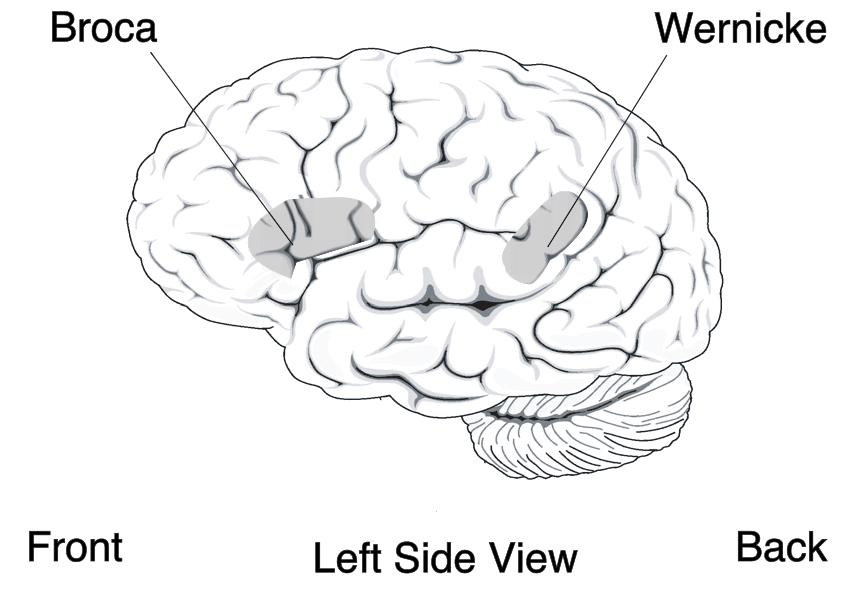


Diagram of the brain showing the location of Broca’s area and Wernicke’s area.


It makes sense that the same parts of your brain are used for reading, listening, and speech, because you are using the same vocabulary and grammar for all three activities. But what’s interesting is that reusing the same parts of your brain means reading, listening, and speaking are mostly the same thing. When you read, you can meaningfully say you are speaking the words to yourself and listening to them in order to make sense of them. The observation that we sometimes “hear” a text in our own voice as we read it is not an illusion, or even a side effect : it is fundamental to how we do language.


Not only that, but reading, listening, and speaking all light up other parts of your brain which deal with memory and imagination, and they all do it in the same way. As you read, you create mental simulations of the narrative that involve multiple senses and include creative imaginings of things which are not even mentioned. Whether you speak of cheese, hear of cheese, or read about cheese, you see, smell, and taste the cheese. You even see where it is – perhaps on a cheese-board, or in your hand – regardless of whether that detail is in the narrative. As you read a text, you are continually adding to your mental simulation, and this helps you notice when something does not make sense.


When a text does not follow the same rules as speech, the result is confusion : it seems wrong because reading is a form of listening and of speech. You stumble over the text as you would if you were speaking the words aloud or listening to them.


This is what happened when you read Dan Ariely’s sentence. You heard


Zoe and the other kids to whom I offered the same deal was completely blinded by


and by the time you got to was you had already built up a mental simulation of the first part of the sentence with some kids (plural) in it. Your brain had trouble making was (singular) fit with this mental picture. To describe this situation we say there is an error in subject-verb agreement.


I agree that Dan Ariely intended the commas to delimit a parenthesis, a remark which you insert into the middle of a sentence as if you are interrupting yourself. A parenthesis contributes to the meaning of the sentence but interrupts and stands outside its syntax. Wikipedia derives the word from the Greek παρένθεσις, meaning “to place alongside of”.


The remark


and the other kids to whom I offered the same deal


will work as a parenthesis if you hear it like one when you speak it to yourself. The trouble is that it also happens to work within the syntax of the sentence, leading you down the garden path until you encounter the word was. Commas are not always enough to cue a parenthesis. Dan should have used round brackets (parentheses) – or even dashes – to guide the reader to treat the interruption as an interruption.


Further Reading


 2009 Cook/Dehaene Scientific American “Your Brain on Books : Neuroscientist Stanislas Dehaene explains his quest to understand how the mind makes sense of written language”.
 2011 Stafford/Blackburne “What happens in the brain when you read : A Conversation with Livia Blackburne”.
 2012 Bergen Louder Than Words : The New Science of How the Mind Makes Meaning.
 2012 Paul The New York Times “Your Brain on Fiction”.
 2013 “scicurious” Neurotic Physiology (blog) “Silent reading isn’t so silent, at least, not to your brain”.
 2013 Wikipedia “Broca’s area”.
 2013 Wikipedia “Wernicke’s area”.
 2013 Wikipedia “Parenthesis (rhetoric)”.


grammatical number - Subject singular or plural?


I got really confused reading conflicting grammar rules for sentences such as below:


  • First one:


    A number of people is/are going to the party.


    Here, the subject is "A number". Since "A number" is plural, the the correct answer must be


    A number of people are going to the party.


  • Second one:


    His collections of music is/are good.


    Here, the subject is "Collections of music". Since "collections" is a plural, the correct answer must be:


    His collections of music are good.


  • Third one:


    His collection of music is/are good.


    Going by my previous rule, since the subject here is "collection of music", which is singular, the correct answer must be:


    His collection of music is good


But I have seen answers that state the right answer to the second one is "His collections of music is good".


Can someone please elucidate this?


Thanks in advance!


Answer


For the first one, the subject of the sentence is the whole noun phrase a number of people, in which a number of collectively acts as a determiner - a class of words that includes the articles a, an, and the as well as words such as many, most, and every - and people is the head word, which is the root noun which is being modified by the rest of the phrase. Compare to other sentences using related noun phrases with different determiners - for example, you wouldn't think twice about the correctness of "Several people are going to the party" or "Beautiful people are going to the party."


You can also verify this by noting that removing people from the sentence leaves you with "A number of is going to the party" - a nonsense sentence - whereas removing a number of leaves you with the workable sentence "People are going to the party." Even if you take out the of as well, to get "A number is going to the party," it still doesn't make sense unless you're living in some kind of cartoon world; it conjures up images of an anthropomorphic number 7 as the guest of honor.


For the second and third, you're in the right. "His collections are good" and "His collection is good" are the correct forms. My only guess for why you might have seen otherwise is that maybe someone misread the second statement and didn't notice that collections was pluralized, as one normally refers to the entirety of a person's music library as a singular collection.


possessives - Jones's or Jones'?


I've always heard that when talking about stuff belonging to either a Jones or many Jones, you'd write Jones' (pronounced "Joneses"). But recently I've stumbled upon a book which consistently uses Jones's when talking of a single Jones.


What's the correct way of using possesives?

grammar - The time before place mantra


As a Dutch schoolboy, during English grammar lessons (long ago...) I got one rule hammered into my head like a mantra: time before place:


In the 1930s, in England, nobody prepared for war.


But as I gradually got more fluent in English I started to wonder whether this "rule" really made sense. Let me change the sentence a bit:


In the 1930s, in England, nobody prepared for war, whereas in the 17th and 18th centuries everybody did.


Correct grammar, right? (Let history.stackexchange challenge the historical truth). But I think it makes sense to say


In England, in the 1930s nobody prepared for war, whereas in the 17th and 18th centuries everybody did.


because it emphasizes the contrast between the time periods better than in the former sentence.


And when I just say


In England, in the 1930s, nobody prepared for war.


does that sound warped to a native speaker?


So: how valid (or natural) is this rule?


(By the way, later I learned that the full rule is manner before time before place, but let's not go into that — yet).


Answer


You can bring more or less anything to the front of a sentence to give it prominence, so your examples are not the best way to illustrate a fairly solid "rule" in English, namely that time usually occupies the last position. [This is the opposite of what you seem to have learned.] So, we would normally say:


  • I went to the bank yesterday.

  • She usually dines at home on Sundays.

  • We are planning to visit Prague next week.


not:


  • I went yesterday to the bank.

  • She usually dines on Sundays at home.

  • We are planning to visit next week Prague.


If you add manner into the mix, you have a fairly solid rule: manner - place - time:


  • I walked leisurely along the beach all day yesterday.

  • She played very well in the chess tournament last night.


american english - Use Schedule and Timetable together


The context is a course scheduling and the process in creating one: course scheduling. I have looked up, that schedule is typically used American English and timetable is typically used in British English, is that correct?


Then my question would be, how would a native speaker experience it when both terms are used in the same context? Because currently I have the feeling, that I could express myself better when using both.


Schedule seems to be the overall structure, the whole course schedule of the university for example and timetable, more as the timetable for this week: Monday to Friday.


Answer


Course schedule or class schedule would be well-understood in the U.S. to describe one's weekly program, whereas timetable would be quite unusual. Calendar might be applicable for longer periods; the course calendar might include note a public holiday when lecture is canceled and the dates of the midterm and final exams.


In American English, timetable has two general uses. The first denotes a published schedule for transportation arrivals and departures, such as airline flights, package delivery runs, or bus routes. Individuals would not generally have these kinds of timetables for themselves, unless they were pilots or drivers.


The second, on the other hand, refers to the broad time frame it would take to achieve some milestone. What's the timetable for upgrading the whole office to Windows 8? Oh, probably years rather than months. An individual could speak of having a timetable, but it would be a hypothetical and broad estimate, not something to consult. My timetable for finishing graduate school is 2015 or 2016, depending on where I get accepted.


grammaticality - "...at the top or bottom" vs "...at the top or the bottom"

I'm a bit confused about the usage of "the" in a list. Even after reading this post, it's not clear to me which of the following is grammatically correct.


"Is the [object] at the top or bottom?"


"Is the [object] at the top or the bottom?"


Or should "at" be distributed as well? (In which case, it seems clear that "the" should appear twice.)


"Is the [object] at the top or at the bottom?"